Preparedness Starts at Home
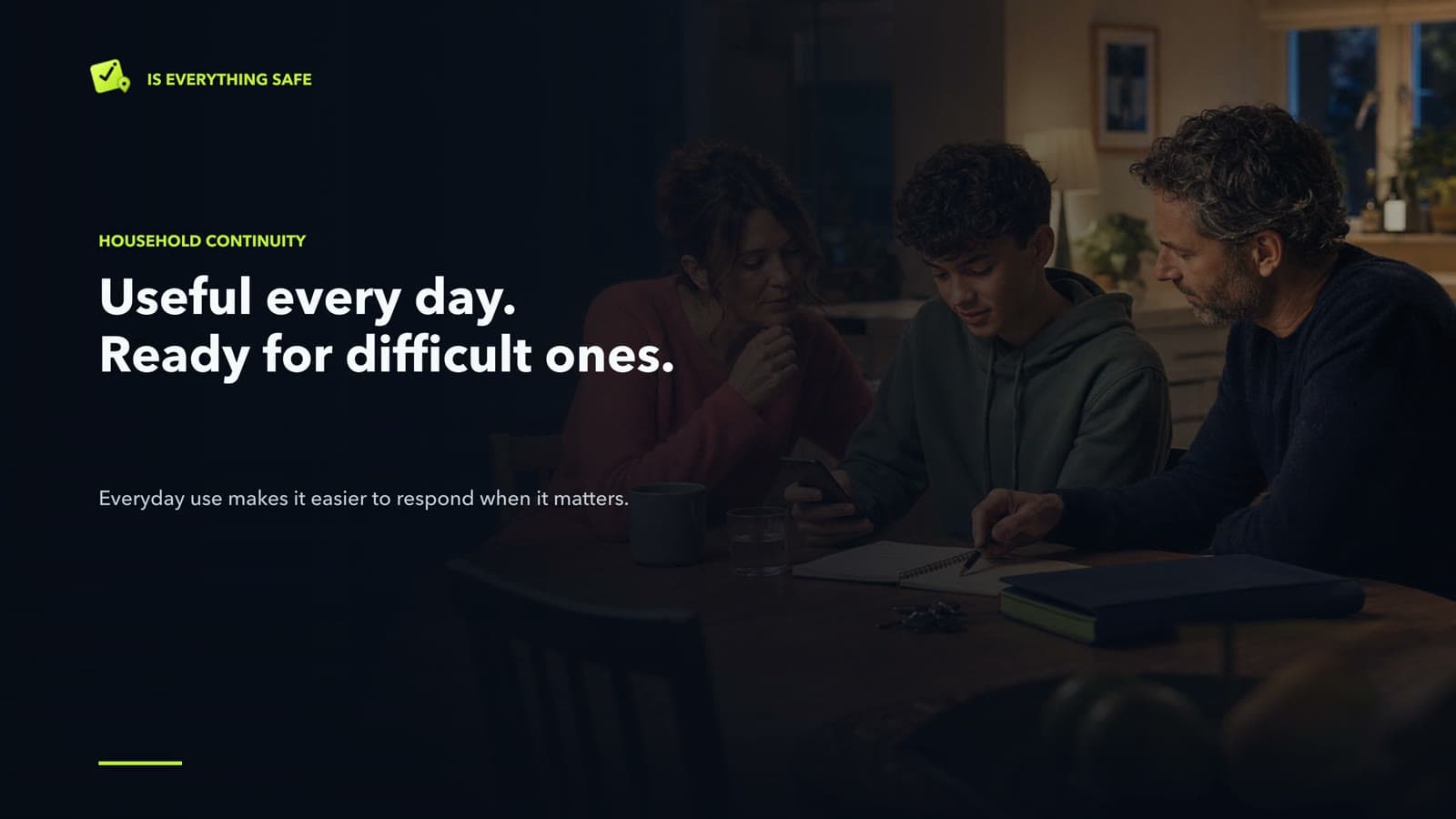
Preparedness is often framed as a national systems issue, but disruption is experienced at household level. Real resilience starts with whether families can stay organised, connected, and ready to act.

When people talk about resilience, they usually talk about systems.
They talk about infrastructure, cyber threats, supply chains, defence, utilities, and public services. Those are all important. But that is not how disruption is actually felt.
Disruption is felt at home.
It is felt when you cannot find the right document quickly enough.
When the insurance information is in one place, the key contact is in another, and the one person who knows what is going on is unavailable.
When an alert comes in, but nobody is sure what it means for the household.
When life does not go to plan, and the admin becomes part of the crisis.
That is a reality I know personally.
Part of the thinking behind IsEverythingSafe came from family experience. Caring responsibilities, serious illness, power of attorney paperwork, insurance documents, end-of-life planning, and the growing pressure of trying to keep important information available when it might suddenly be needed. It became obvious very quickly that this was not just "life admin". It was readiness. It was continuity. It was whether a family could function under pressure.
That experience changed how I think about preparedness.
Preparedness is often presented as something large-scale and institutional. But many of the most important resilience questions facing the UK today point to something much closer to home. Risks may begin at national or international level, but they arrive in people's day-to-day lives. A cyber incident becomes a travel problem. A travel problem becomes a work problem. A work problem becomes a childcare, health, or financial problem.
The risk is systemic. The impact is personal.
That is why I believe one of the biggest gaps in resilience today is not awareness. It is practical household execution.
Most people are not unprepared because they do not care. They are unprepared because preparedness still feels abstract, fragmented, and too easy to postpone. If important information is scattered across drawers, inboxes, phones, folders, and family members, people only discover the weakness when something has already gone wrong.
Preparedness has to become more practical than that.
For me, it starts with a simple idea: helping households stay organised, connected, and able to act when life does not go to plan.
That means being able to find important documents quickly.
It means knowing who the right people are and how to reach them.
It means keeping reminders, responsibilities, and records visible.
It means following trusted information.
It means making sure preparedness is shared, not held in one person's head.
That is where IsEverythingSafe fits.
We are not trying to replace official guidance, public authorities, or emergency services. We are trying to make the everyday layer of preparedness easier for households to manage. The practical layer. The part that too often gets ignored because it does not look dramatic until it suddenly matters.
I think resilience will improve when preparedness becomes part of ordinary life rather than a separate activity people promise themselves they will get round to one day.
Because when disruption happens, households do not need more theory.
They need to be ready to act.
And that is why preparedness, in the end, starts at home.
Sources
- https://nationalpreparednesscommission.uk/wp-content/uploads/2024/02/NPC_HULL_Building-Everyday-Preparedness_112023HD-3.pdf
- https://nationalpreparednesscommission.uk/wp-content/uploads/2024/03/NPC_Making-It-Happen.pdf
Build your household setup before you need it
Keep important records, contacts, reminders, trusted alerts, and ownership information in one place so your household can act earlier and recover with less chaos.